
Veneers
What Is a Dental Veneer?
To achieve an optimum ratio of firmness and high aesthetics, the material used for making veneers is ceramics.
- A dental veneer is a thin cover which helps to achieve high aesthetics with the minimal finishing of teeth
- Veneers can change shape, width, and colour of the existing teeth and are usually put on the front, vital teeth.
- Dental veneer has both functional and aesthetic role, but also numerous advantages in comparison to other prosthesis work.
- They only cover the front part of teeth, so we have to remove much less dental surface when installing them.
- Dental veneer treatment is one of the most popular cosmetic treatments in dentistry around the world.
- The result after dental veneer treatment is a beautiful smile and pleased patient.
1. How long do veneers last on my teeth?
After veneers are placed on patient’s teeth, it is essential that patient comes to regular check-ups to his dentist so that a dentist can keep track of veneer’s condition, as well as the overall patient’s dental condition. Longevity of veneers is approximately five years, but with regular oral hygiene and regular check-ups, the durability of veneers can be considerably longer.
2. What do veneers do to your teeth?
- Veneers are thin covers which are used to achieve high aesthetics with the minimal finishing of tooth substance. Veneers can change shape, width, and color of existing teeth and are usually placed on the front, vital teeth.
3. Why are veneers a good choice for your teeth?
A porcelain veneer is a very successful option in situations where a natural tooth is bad in colour, shape, and contour. In cases when we can’t whiten the patient’s teeth, porcelain veneers are an excellent option.
Advantages:
- The advantage of porcelain veneer is that it is almost impossible to notice the difference between porcelain veneer and natural tooth because porcelain veneer is specially formed for each patient
- With porcelain veneer, patient’s natural teeth remain mostly intact
- If teeth whitening treatment isn’t suitable for a patient, porcelain veneers can help
- They are recommended when little gaps between the teeth need to be filled
4. Composite Veneers VS Porcelain Veneers:
- Composite veneers are cheaper and quicker version of porcelain veneers
- Composite veneers are the less invasive way of restoring a beautiful smile
- Composite veneers can be finished in only one visit to the dentist, unlike porcelain veneers
- In comparison to porcelain veneers they don’t look as natural
- Restoration and replacement of composite veneers is considerably cheaper in comparison to porcelain veneers
In our clinic, we use dental veneers for achieving high aesthetics of your smile. Because we strive for perfection in our work, our architects of a smile use the most modern materials to achieve perfectly beautiful and natural new smile for our patient. If you want to have a perfect smile and are looking for the best dental veneers, turn to us with confidence! We will thoroughly examine your dental state and make a precise therapy plan which will be created especially for you.
Porcelain Veneers
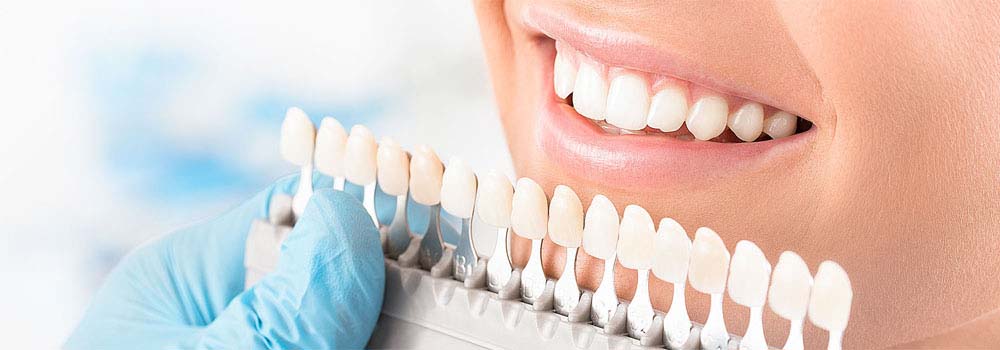
Porcelain veneers are thin pieces of porcelain used for recreating a natural look of a tooth, and additionally, they provide strength and resistance that can be compared to natural teeth enamel. A porcelain veneer is a rehabilitation tool that usually compensates for the frontal tooth surface, and they are a cosmetic dentistry tool. When it comes to veneer, porcelain is often material of choice for those patients who want to change small position alterations or for patients who want to change shape, size and/or color of a tooth.
Composite Veneers
- Composite Veneers are usually used for fixing cosmetic problems with patient’s teeth such as cracks and scrapes.
- Also, composite veneers can be used for attaching slightly distorted teeth and correcting smaller space between front teeth.
- Their longevity is limited to 5 to 7 years if you perform regular oral hygiene and go to regular check-ups with your dentist.
- Proper maintenance of composite veneers depends solely on the patient.
Emax (Lithium Disilicate) Veneers
- Emax (Lithium Disilicate) Veneers are nowadays presented as a technological standard of veneer production. Lithium Disilicate glass – ceramics is suitable for making veneers both on front and back teeth.
- Because they look natural and have excellent light-optic characteristics, this material gives extraordinary results.
- The material is extremely high quality and suitable for advanced CAD/CAM technology which gives teeth natural look and longevity.
- This type of veneers is extremely solid, and of high aesthetic, preparation is minimally invasive, and they last for a very long time.
Contact us
General Inquiries
Address
-
Marko Nestoroski Street, No.147, Ohrid
Hours
-
Mon-Fri 9:00AM — 6:00PM