
Dental Implants
What are dental implants?
A dental implant is a titanium screw that substitutes the root of a tooth; its design is based on the design of a natural tooth. Materials used to make implants are biocompatible, and they will last a long time if a patient follows the instructions regarding oral hygiene and comes to regular check-ups to his dentist, even if the dentist is overseas.
Patient Benefits
- Perfect aesthetics
- Natural look of a tooth
- A perfect smile
- Adjacent teeth remain intact
In the smile design, Dental Center Dr. Batkoski uses world-class materials. That is why we overcome a functional and aesthetic challenge of a lost tooth using Ditron implant system. This system complements a perfect smile with its quality and characteristics. You could say that dental implantology is a milestone in a life of a patient who struggles with the problem of toothlessness. It allows them to have fixed teeth units, and getting those dental implants abroad is most of the time the best solution.
1. What are All-on-4 Dental Implants?
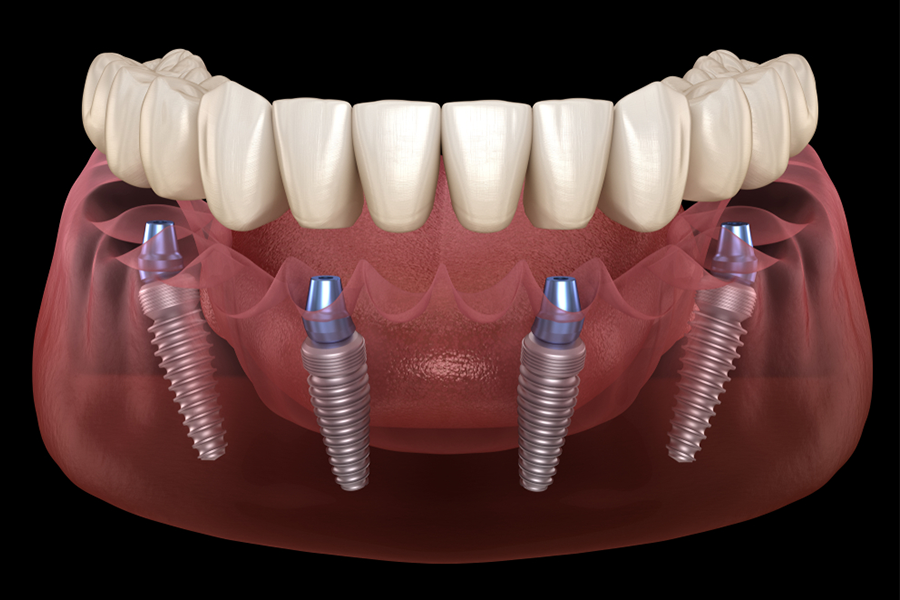
All-on-4 is a concept where an utterly toothless jaw is equipped with four implants that hold a fixed bridge. That allows patients who have the total prosthesis and who are toothless to have fixed implant prosthesis instead of a removable prosthesis which have to be taken out and put back in daily.
Dental implants are a long-term solution for missing tooth or teeth, and if a patient takes care of his oral hygiene and comes to regular check-ups at a dentist, we give a 10 years guarantee.
All-on-4 Allows:
- Solving toothlessness in a short period.
- Reducing the number of patient’s visits as well as the complete duration of treatment.
- Soreness-free therapy and recovery.
- High-quality results.
All-on-4 Benefits:
- A short time of recovery
- Bone and sinus lift upgrade is excluded
- The natural look of a face
- Minimal recovery time
- Long-term solution
- Hygiene
2. The All-on-4 Dental Implants Procedure Explained
- Before installing All-on-4, a patient goes through a detailed dental examination that consists of the check-up, consultations with dentists and a variety of diagnostic procedures.
- After a detailed examination, we confirm if a patient is a candidate for the All-on-4 method. When it is confirmed that a patient is an ideal candidate, he will be given a new smile in only one day.
- In just one day we install four dental implants, reconstruction, and temporary teeth.
- After a few months when dental implants have grown together with a bone, a permanent bridge is developed for a patien
3. The All-on-6 Procedure
Dental implants are a long-term solution for missing tooth or teeth, and if a patient takes care of his oral hygiene and comes to regular check-ups with his dentist, the guarantee is life-long.
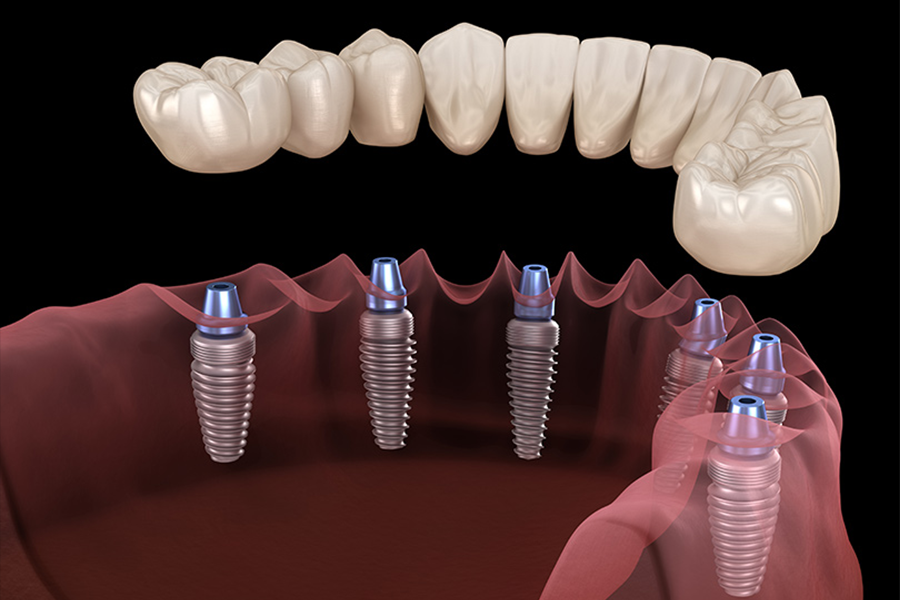
All-on-6 is a concept where an utterly toothless jaw is equipped with six implants that hold a fixed bridge. That allows patients who have the total prosthesis and who are toothless to have fixed implant prosthesis instead of a removable prosthesis which have to be taken out and put back in daily.
All-on-6 Allows:
- Solving toothlessness in a short period.
- Reducing the number of patient’s visits as well as the complete duration of a therapy.
- Soreness-free therapy and recovery.
- High-quality results.
4. The All-on-6 Dental Implants Procedure Explained
The All-on-6 method is simple. First of all, a detailed first examination is needed where the patient’s dental condition will be established. During the examination, the patient will consult our dentists, express his wishes and needs, and undergo various detailed diagnostic procedures.
After the examination and diagnostic procedures, dentists will decide if you are a perfect candidate for All-on-6 and give you a comprehensive plan of therapy and financial offer that does not commit you to anything.
The all-on-6 method begins with giving anesthesia so the whole procedure is painless, and during one procedure we install 6 dental implants, extension, and temporary teeth.
After that, a patient can go home and continue with the standard way of life. It is recommended that the patient doesn’t eat until anaesthesia entirely runs down. During a couple of months after the procedure (3 to 6 months, depending on the case) it is recommended to eat soft food and to avoid food that requires strong chewing, crunchy food, and seeds.
When a dental implant coalesces into the bone, after three to six months, a fixed bridge is installed, and a patient can go home with a normal functioning jaw.
5. All-on-4 vs All-on-6?
Both methods (All-on4 and All-on-6) have the same goal, which is solving patient’s toothlessness. Both methods require the same process of installation and both methods are painless because they are conducted under anaesthesia.
All-on-4 and All-on-6 differ in the number of dental implants. All-on-4 is a concept where the utterly toothless jaw is equipped with four dental implants that hold a fixed bridge, whereas All-on-6 is a concept where the utterly toothless jaw is equipped with six dental implants that hold a fixed bridge.
Also, an All-on-6 method is recommended for patients who have reduced bone density as an installation of dental implants stimulates bone growth and gives the patient a more defined jaw appearance.
Whether All-on-4 or All-on-6 will be installed depends on the patient’s dental condition, his needs and the best solution for him.
6. What It's Used For Sinus LIFT
A sinus lift is done when there is not enough bone height in the upper jaw, or the sinuses are too close to the jaw, for dental implants to be placed. There are several reasons for this:
- Many people who have lost teeth in their upper jaw — particularly the back teeth, or molars — do not have enough bone for implants to be placed. Because of the anatomy of the skull, the back of the upper jaw has less bone than the lower jaw.
- Bone may have been lost because of periodontal (gum) disease.
- Tooth loss may have led to a loss of bone as well. Once teeth are gone, bone begins to be resorbed (absorbed back into the body). If teeth have been missing for a long time, there often is not enough bone left to place implants.
- The maxillary sinus may be too close to the upper jaw for implants to be placed. The shape and the size of this sinus varies from person to person. The sinus also can get larger as you age.
All-on-4 Dental Implants
In our clinic, a perfect smile based on Perfect Smile is imperative. To create an ideal smile, it is necessary to follow world trends in dentistry and technology and to educate ourselves continually. That is why our architects of a smile can create a perfect smile even in cases such as complete toothlessness or loss of the considerable number of teeth. Teeth loss that is caused by inadequate treatment, trauma or the natural process of aging, damages the quality of life and that is why teeth must be restored. In cases where a large number of teeth, or all teeth, are lost, a new smile can be achieved with an All-on-4 method. Contact us and make sure that you are a candidate for All-on-4.
All-on-6 Dental Implants
When it comes to a perfect smile, there is no compromise in our clinic. We think that a smile is the strongest form of expressing ourselves that we, as individuals, possess. It overcomes cultural, social and all the other barriers. A smile will always connect people by manifesting emotion, sensuality, and foremost – humanity. Our philosophy and our vision of your bright future motivate us to create a perfect feeling for you if you have lost a large number of teeth or are entirely toothless. We follow world trends in dentistry and technology and continuously educate ourselves which is why we consider ourselves to be your ideal choice for architects of a smile with method All-on-6 if you have lost the significant number of teeth or are entirely toothless. Contact us and check if you are a candidate for All-on-6.
Sinus Lift
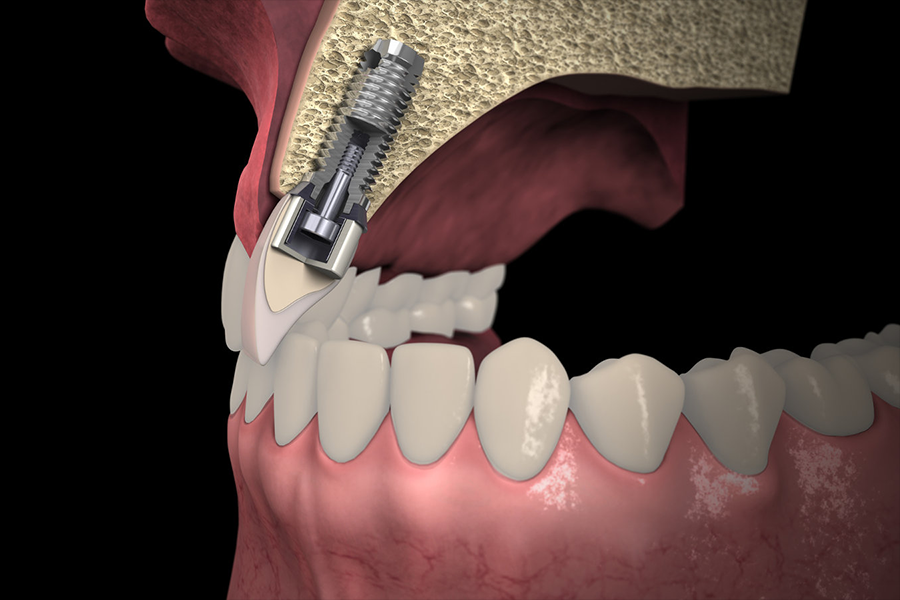
The upper back jaw has traditionally been one of the most difficult areas to successfully place dental implants due to insufficient bone quantity and quality and the close proximity to the sinus. If you’ve lost bone in that area due to reasons such as periodontal disease or tooth loss, you may be left without enugh bone to place implants. Sinus lift surgery can help correct this problem by raising the sinus floor and developing bone for the placement of dental implants.
What Is It?
A sinus lift is surgery that adds bone to your upper jaw in the area of your molars and premolars. It’s sometimes called a sinus augmentation. The bone is added between your jaw and the maxillary sinuses, which are on either side of your nose. To make room for the bone, the sinus membrane has to be moved upward, or “lifted.” A sinus lift usually is done by a specialist. This could be either an oral and maxillofacial surgeon or a periodontist.
Sinus lifts have become common during the last 15 years as more people get dental implants to replace missing teeth.
Contact us
General Inquiries
Address
-
Marko Nestoroski Street, No.147, Ohrid
Hours
-
Mon-Fri 9:00AM — 6:00PM